

Worshiping Jesus or Worshiping Power?
- St. Luke's

- Aug 23, 2025
- 6 min read
The Rev. Sara Warfield
Scripture: Luke 13:10-17
At some point, I’m sure you’ve heard someone out there talk about “the letter of the law and the spirit of the law.” The letter of the law is the specific way a law is articulated, while the spirit of the law is the reason why the law was written in the first place.
For example, the letter of the law might say that your child’s bedtime is 9 p.m., but the spirit of the law is that your child is healthier and more joyful when they get nine or ten hours of sleep every night.
The letter of the law might say that I, as rector of this parish and the primary worship leader, am only allowed to use liturgies formally approved by The Episcopal Church and/or my bishop, but the spirit of the law is that The Episcopal Church is itself one large worshiping community, and we are all enriched when, across all our dioceses and parishes, we’re using the same liturgies, learning the same language and rhythm of worship.
The letter of the law might say that a person who is not a citizen of this country must have proper documentation to enter and stay in this country, but the spirit of the law is to maintain sustainable levels of immigration and screen those who are entering in order to protect the people of this country.
In our gospel today, the letter of the law, according to the leader of the synagogue, is “There are six days on which work ought to be done; not on the sabbath day.” The spirit of that law derives from two different Hebrew Bible scriptures: The first is from Genesis, chapter 2: “By the seventh day God had finished the work God had been doing; so on the seventh day God rested.” The spirit of the sabbath is to rest on the seventh day because that’s when God rested. The second is from Deuteronomy, chapter 5:
Six days you shall labor and do all your work, but the seventh day is a sabbath to the Lord your God. Remember that you were slaves in Egypt and that the Lord your God brought you out of there with a mighty hand and an outstretched arm. Therefore the Lord your God has commanded you to observe the Sabbath day.
God gave rest to the Israelites by freeing them from the Egyptians, therefore they honor that rest by keeping the Sabbath.
But what if your child’s favorite uncle just happens to be in town on a surprise overnight layover and he arrives at the house at 8:55 p.m.? What if I discover a Eucharistic Prayer from the South African Anglican Church that speaks perfectly to the intense division of our world today? What if a citizen from a different country is being threatened with harm by the situation in their own land and flees to the safety of this country without the proper documentation?
What if a woman who had been bent over and quite unable to stand up straight for eighteen years walks into the synagogue on the Sabbath when Jesus, a healer, is present?
Letter of the law and spirit of the law. Both are important. The letter gives us clear parameters to follow, helps us to know and assert our boundaries with one another, and boundaries at their best serve to keep everyone safe and healthy. And the spirit gives us the reasoning for the law, perhaps pointing to the memory of past pain or history of past success that can inform what health and safety look like within relationships—individual, congregational, national, or even international relationships.
The existence of written laws and rules assume a certain degree of stability and predictability within a community, and a general agreement about what health and safety mean. But, as illnesses and injuries, earthquakes and hurricanes show us, life is never perfectly stable or predictable. As the pandemic showed us, we don’t always agree about what health and safety mean.
There are always contingencies, always surprises that challenge our rules and laws as we understand them. An uncle, a foreign liturgy, an undocumented immigrant, a crippled woman.
What Jesus is telling us in this gospel is that when these contingencies, these surprises, arise, we can react in two different ways: either clinging to the letter of the law or discerning how those contingencies relate to the spirit of the law.
—
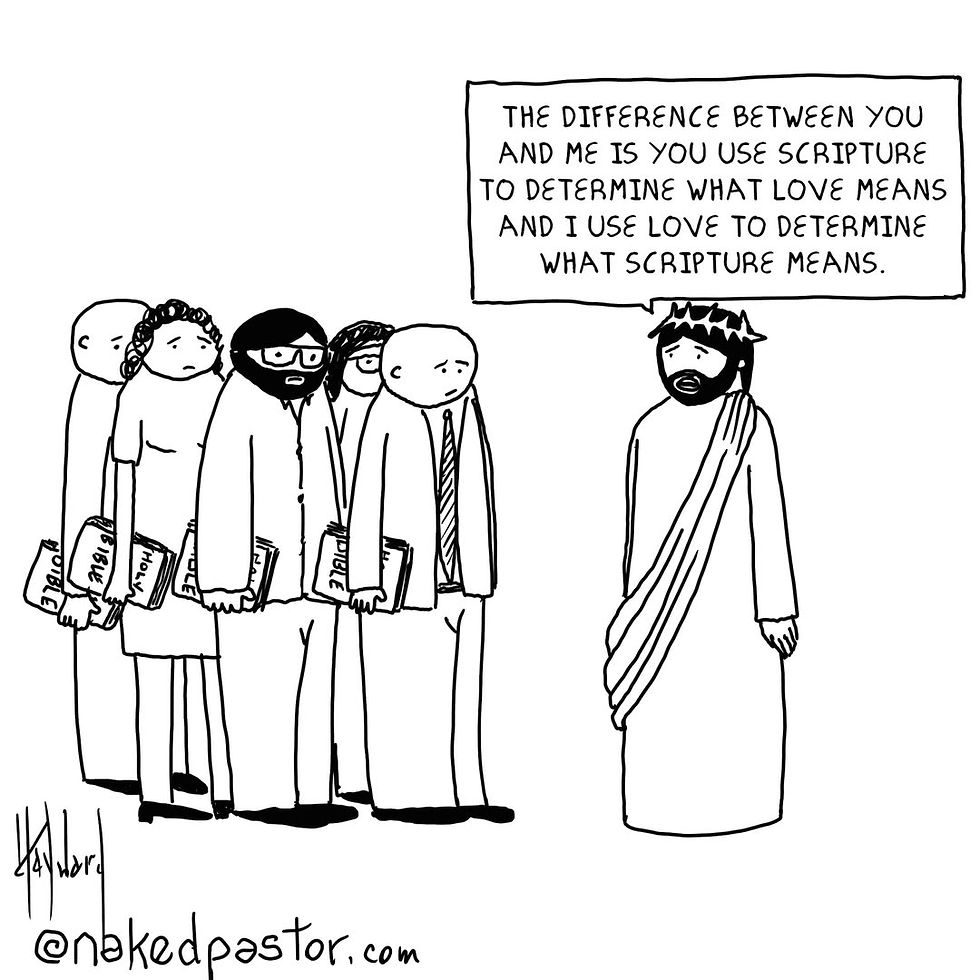
A week or two ago, my mom posted a drawing on Facebook from Naked Pastor, a popular progressive Christian artist. It pictured Jesus talking to what looks like a bunch of pastors. Jesus says to them, “The difference between you and me is you use scripture to determine what love means, and I use love to determine what scripture means.”
He says something similar to the leader of the synagogue and those gathered when the leader insists that healing shouldn’t happen on the Sabbath: "You hypocrites!” Jesus says:
Does not each of you on the sabbath untie his ox or his donkey from the manger, and lead it away to give it water? And ought not this woman, a daughter of Abraham whom Satan bound for eighteen long years, be set free from this bondage on the sabbath day?
The letter of the law says to rest on the sabbath day, as the synagogue leader asserts, but the spirit of the law is in one sense, yes, to rest, but in the larger sense is to honor God, both in God’s resting after making the world AND in God setting God’s people free from bondage.
What better way to honor the Sabbath, to honor God, than to give this woman rest from her affliction, than to set her free from her bondage?
“The difference between you and me,” Jesus says, “is you use scripture to determine what love means, and I use love to determine what scripture means.”
In other words, for Christians the spirit of any law, of any rule, is always love.
But the leader of the synagogue was prioritizing the letter of the law. Why? I think the most generous answer I can give is that it provides him a sense of order, a sense of certainty. That’s what laws and rules are for, at their best. They give us guidance when there is uncertainty, a structure to guide us when there is harm or abuse.
But the prioritization of order and certainty, the letter of the law, at the expense of love and liberation, the spirit of the law, is usually in service to maintaining control and power.
When we say “Because I said so” to our children without providing any other explanation we’re prioritizing the letter of the law, reminding them that we are the law, over providing a reason, a way for them to understand why that restriction is in place—the spirit of the law. When we say “because I said so,” it’s to maintain control and power.
We’re living in a country where currently many of our laws and rules are being shaped by Christian Nationalism. Christian Nationalism is the very picture of using the scripture to determine what love is rather than the other way around. The whole approach of Christian Nationalism is to prioritize certain parts of the Bible that prioritize order and certainty over the love and liberation that Jesus taught. Their motto could be, “Because I said so, and I’m a REAL Christian.”
Now I’m always reluctant to state what I think “real” Christianity is, because I have seen different ways of believing and practicing give life and purpose to different kinds of people. But in these troubled days I think it’s important to take a stand, as Jesus did in the synagogue. If our faith is the belief in and emulation of Christ, as the term “Christianity” implies, then Christianity is the willingness to say, “You hypocrites! Did not the savior we claim to worship teach us that loving God and loving our neighbors as ourselves are the two greatest commandments, the two on which all the prophets and, yes, all the laws depend?”
For Christians, the spirit of the law is always love. When we prioritize certainty and order over love and liberation, then we’re no longer worshiping Jesus, we’re worshiping power.
Amen.


Comments